Publications
2026
-
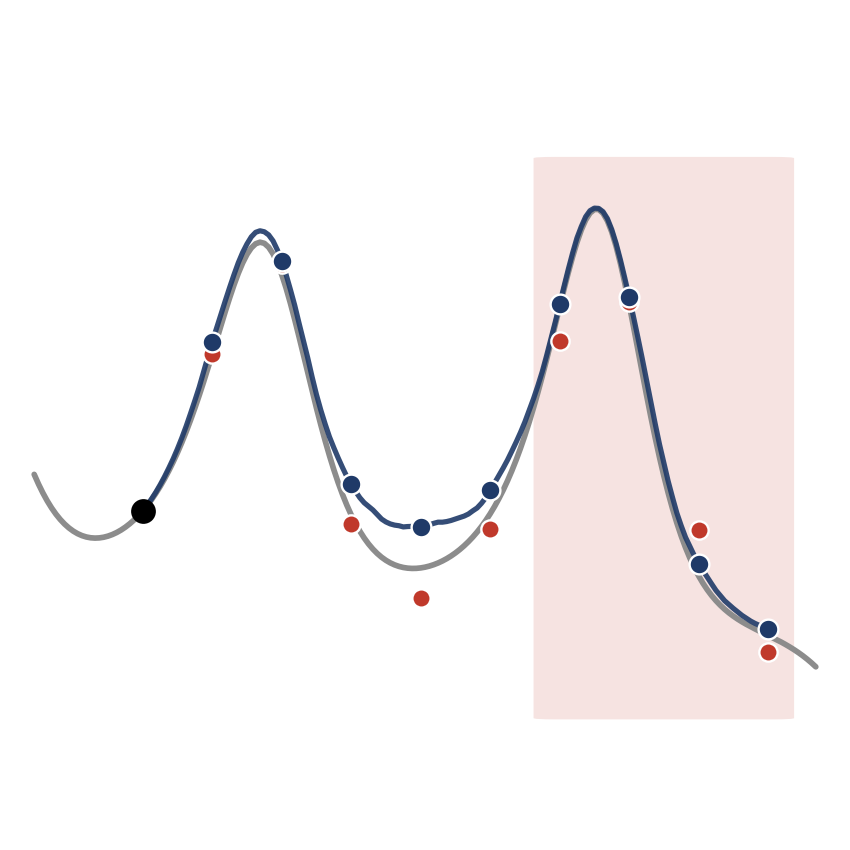 DAWIS: Data Assimilation with Windowed Inverse Sampling via Multitask InterpolantsErik Wikingsson, Martin Andrae, Tomas Landelius, and Fredrik Lindsten2026
Flow- and diffusion-based generative models have recently emerged as flexible and highly efficient forecasting models for dynamical systems. When combined with inference-time guidance, they offer a promising route to high-dimensional non-Gaussian data assimilation (DA), the problem of combining forecasts with observations to estimate latent system states. Existing filters, however, condition on a fixed history and assimilate only the most recent observation, leaving them unable to revise past states when new observations arrive. Estimates then stay tethered to a history that later observations may contradict, and errors accumulate over the assimilation run. To this end, we introduce DAWIS, a unified DA method covering filtering, fixed-lag smoothing, and block smoothing within a single framework. DAWIS replaces the single flow time of a state-level prior with a multitask stochastic interpolant over a window of consecutive states, assigning a separate flow time to each. An assimilation cycle inverts the window to a vector of per-state turning points and regenerates it under observation guidance, with the turning points controlling how strongly each state is held fixed, revised, or generated from scratch. The same construction can also absorb the forecast into the assimilation cycle, removing the need for a separate forecasting model. Experiments on challenging nonlinear systems show that DAWIS improves on both filtering and smoothing baselines under sparse, noisy, and nonlinear observations.
@misc{wikingsson2026dawis, title = {DAWIS: Data Assimilation with Windowed Inverse Sampling via Multitask Interpolants}, author = {Wikingsson, Erik and Andrae, Martin and Landelius, Tomas and Lindsten, Fredrik}, year = {2026}, eprint = {2610.03314}, archiveprefix = {arXiv}, primaryclass = {stat.ML}, } -
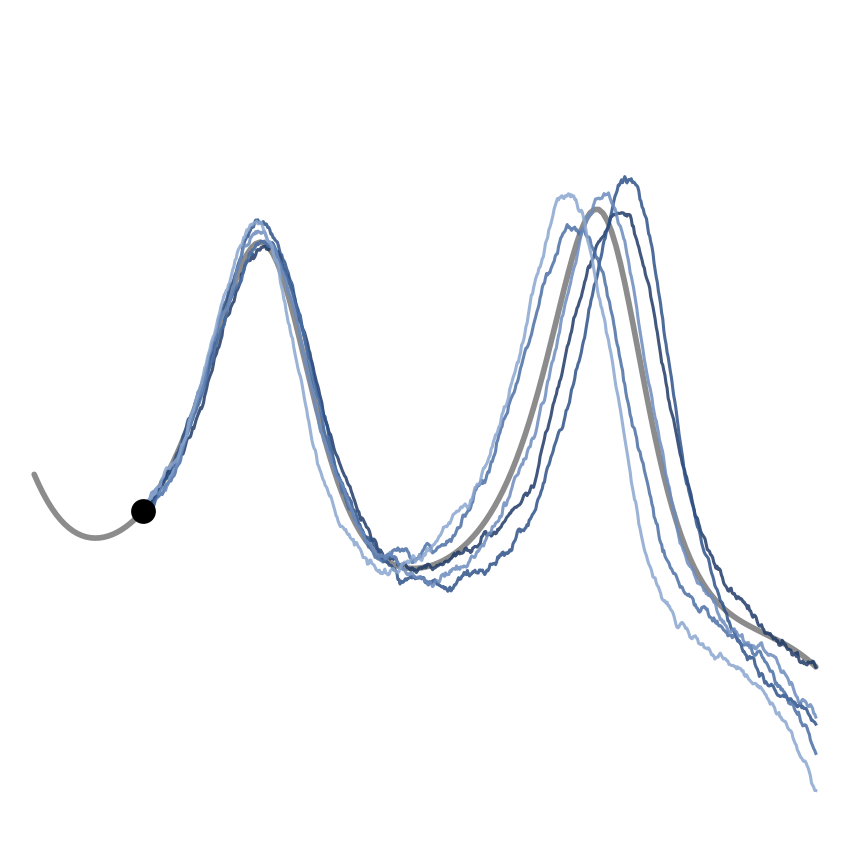 SDECast: Probabilistic Weather Forecasting in Continuous Time with Neural SDEsMaria Marchenko, Martin Andrae, Fredrik Lindsten, and Christian A. Naesseth2026AI for Stochastic Dynamics and Sim2Science workshops at NeurIPS 2026
Existing machine learning weather forecasting models typically generate forecasts through autoregressive rollouts at a fixed temporal resolution. While highly efficient for long-range prediction, this formulation can suffer from severe error accumulation when used with shorter time steps and does not explicitly encode the locality and temporal continuity of atmospheric dynamics. To address these limitations, we introduce SDECast, a Neural Stochastic Differential Equation (SDE) framework for continuous-time probabilistic weather forecasting. SDECast extends SDE Matching to learn stochastic dynamics directly in physical space, without requiring repeated SDE simulation during training. On a simulated geophysical flow, we show that SDECast recovers meaningful drift dynamics and faithfully reproduces the underlying continuous-time behavior. We then demonstrate its scalability to global weather forecasting at hourly resolution, where SDECast produces skillful probabilistic forecasts for lead times of up to five days.
@misc{marchenko2026sdecast, title = {SDECast: Probabilistic Weather Forecasting in Continuous Time with Neural SDEs}, author = {Marchenko, Maria and Andrae, Martin and Lindsten, Fredrik and Naesseth, Christian A.}, year = {2026}, eprint = {2610.03313}, archiveprefix = {arXiv}, primaryclass = {stat.ML}, note = {AI for Stochastic Dynamics and Sim2Science workshops at NeurIPS 2026}, } -
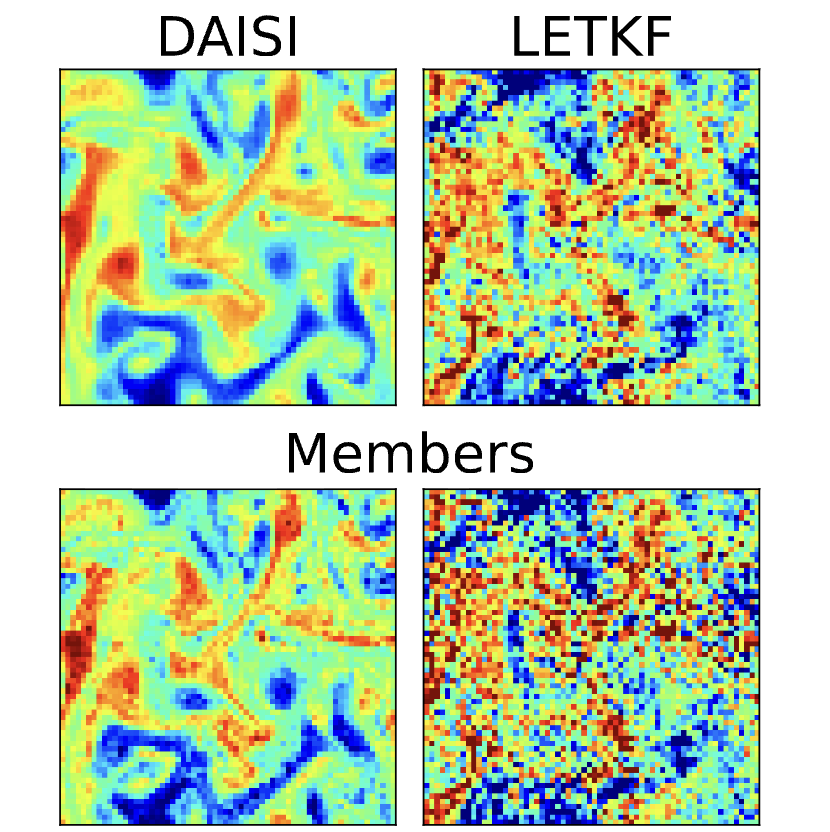 DAISI: Data Assimilation with Inverse Sampling using Stochastic InterpolantsMartin Andrae, Erik Larsson, So Takao, Tomas Landelius, and Fredrik LindstenIn Proceedings of the 43rd International Conference on Machine Learning, 2026
Data assimilation (DA) is a cornerstone of scientific and engineering applications, combining model forecasts with sparse and noisy observations to estimate latent system states. Classical high-dimensional DA methods, such as the ensemble Kalman filter, rely on Gaussian approximations that are violated for complex dynamics or observation operators. To address this limitation, we introduce DAISI, a scalable filtering algorithm built on flow-based generative models that enables flexible probabilistic inference using data-driven priors. The core idea is to use a stationary, pre-trained generative prior that first incorporates forecast information through a novel inverse-sampling step, before assimilating observations via guidance-based conditional sampling. This allows us to leverage any forecasting model as part of the DA pipeline without having to retrain or fine-tune the generative prior at each assimilation step. Experiments on challenging nonlinear systems show that DAISI achieves accurate filtering results in regimes with sparse, noisy, and nonlinear observations where traditional methods struggle.
@inproceedings{andrae2026daisi,
  title = {DAISI: Data Assimilation with Inverse Sampling using Stochastic Interpolants},
  author = {Andrae, Martin and Larsson, Erik and Takao, So and Landelius, Tomas and Lindsten, Fredrik},
  booktitle = {Proceedings of the 43rd International Conference on Machine Learning},
  year = {2026},
}
2025
-
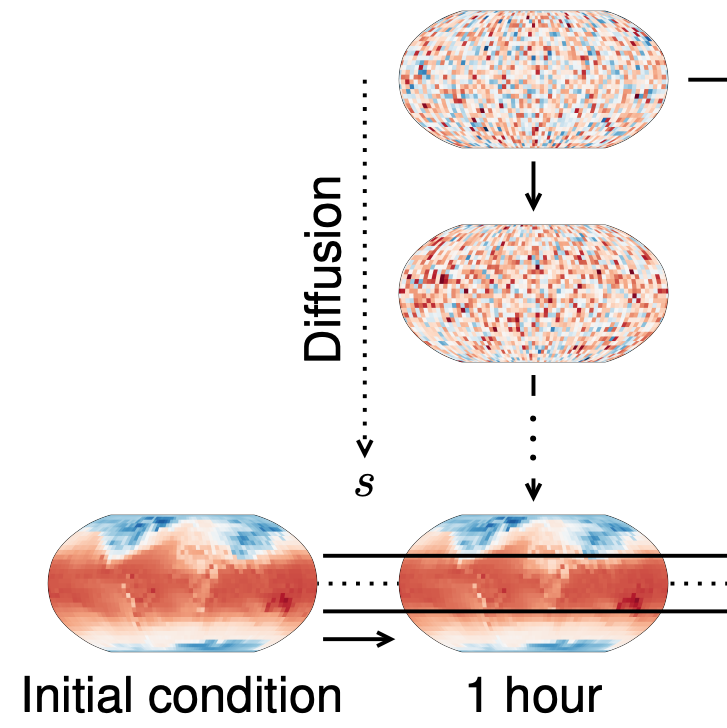 Continuous Ensemble Weather Forecasting with Diffusion modelsIn The Thirteenth International Conference on Learning Representations, 2025
Weather forecasting has seen a shift in methods from numerical simulations to data-driven systems. While initial research in the area focused on deterministic forecasting, recent works have used diffusion models to produce skillful ensemble forecasts. These models are trained on a single forecasting step and rolled out autoregressively. However, they are computationally expensive and accumulate errors for high temporal resolution due to the many rollout steps. We address these limitations with Continuous Ensemble Forecasting, a novel and flexible method for sampling ensemble forecasts in diffusion models. The method can generate temporally consistent ensemble trajectories completely in parallel, with no autoregressive steps. Continuous Ensemble Forecasting can also be combined with autoregressive rollouts to yield forecasts at an arbitrary fine temporal resolution without sacrificing accuracy. We demonstrate that the method achieves competitive results for global weather forecasting with good probabilistic properties.
@inproceedings{andrae2025continuous,
  title = {Continuous Ensemble Weather Forecasting with Diffusion models},
  author = {Andrae, Martin and Landelius, Tomas and Oskarsson, Joel and Lindsten, Fredrik},
  booktitle = {The Thirteenth International Conference on Learning Representations},
  year = {2025},
}